
Record Participation and Baku Call to Action Define WUF13
On 22 May, discussions on urban planning, climate-resilient urbanisation and sustainable development continued into the final day of the thirteenth session of the World Urban Forum (WUF13) in Baku, held under the theme “Housing the world: Safe and resilient cities and communities”.
The sixth day of WUF13 featured a broad programme of dialogues, special sessions and caucuses, culminating in the Forum’s official closing and flag-lowering ceremonies.
As part of the Forum, the Women’s Roundtable titled “Adequate housing for gender equality and the empowerment of women” was held. The event brought together United Nations Deputy Secretary-General Amina Mohammed; Executive Director of UN-Habitat Anacláudia Rossbach; Chairperson of the State Committee for Family, Women and Children Affairs of the Republic of Azerbaijan Bahar Muradova; and Rt Hon Patricia Janet Scotland, member of the UK House of Lords and sixth Secretary-General of the Commonwealth of Nations.
Discussions focused on strengthening women’s housing rights and secure land tenure, promoting inclusive urban development, ensuring safer urban environments and advancing sustainable urbanisation. Speakers emphasised that inclusive housing policies, expanded access for women to financial and credit resources, and their more active participation in urban planning and decision-making processes play a vital role in shaping more sustainable, safe and inclusive cities.
At the session titled “Post-Conflict Urban Reconstruction: The Critical Role of Humanitarian Mine Action” held within the framework of WUF13, Vugar Suleymanov, Chairman of the Board of the Azerbaijan National Agency for Mine Action (ANAMA), addressed participants. Discussions focused on the impact of landmine contamination on post-conflict recovery and reconstruction processes, as well as issues related to sustainable urban development and ensuring public safety.
In his remarks, Vugar Suleymanov said the threat posed by landmines continues to slow recovery efforts not only in Azerbaijan, but across many parts of the world, restricting development and creating serious risks for civilian populations. He noted that, since 2020, Azerbaijan has carried out large-scale humanitarian mine action operations, clearing more than 270,000 hectares of land of mines and unexploded ordnance and neutralising over 250,000 mines and explosive devices.
He further added that, within the framework of the Great Return Programme, demining activities have been fully integrated into urban planning, reconstruction and broader development processes.
As part of WUF13 hosted by Baku, a panel discussion titled “From Urbicide to Revival: Sustainable Restoration, Resettlement and Development in the Aghdam, Fuzuli, Khojavend, Jabrayil, Gubadli and Zangilan Districts” was held. Speakers included Emin Huseynov, Special Representative of the President of the Republic of Azerbaijan in the Aghdam, Fuzuli and Khojavend districts; Vahid Hajiyev, Special Representative of the President of the Republic of Azerbaijan in the Jabrayil, Gubadli and Zangilan districts; and Marcelina Zielinski, Board Director at Chapman Taylor Group.
Discussions focused on reconstruction efforts across the liberated territories, sustainable resettlement, contemporary urban planning approaches and post-conflict urban development. Speakers noted that projects throughout the region are being implemented in line with the “smart city” and “smart village” concepts. Extensive work is underway to build sustainable infrastructure in newly established communities, expand the use of green energy solutions, introduce digital governance systems, develop social infrastructure and create comfortable living conditions for returning residents.
Elsewhere at WUF13, the Forum hosted its first-ever event focused on the rights of Indigenous peoples. Speaking at the Roundtable on the Rights of Indigenous Peoples, Executive Director of the Baku International Multiculturalism Centre (BIMC) Ravan Hasanov described Indigenous communities as vital guardians of humanity’s cultural memory and historical heritage. He stressed that safeguarding their rights is not simply a legal or political duty, but also a moral and humanitarian imperative.
Ravan Hasanov further emphasised that urbanisation processes should under no circumstances lead Indigenous peoples and ethnic communities to lose their identity, language or cultural memory. On the contrary, he noted, cities should evolve into inclusive spaces where diverse ethnic and religious communities feel safe, respected and equal.
On the final day of the thirteenth session of the World Urban Forum, a closing press conference was held featuring United Nations Deputy Secretary-General Amina Mohammed; Chairman of the State Committee on Urban Planning and Architecture of the Republic of Azerbaijan and WUF13 National Coordinator Anar Guliyev; Executive Director of UN-Habitat Anacláudia Rossbach; and Ambassador of Mexico to Azerbaijan María Victoria Romero Caballero.
Speaking at the official closing ceremony, Anar Guliyev said that, by hosting the prestigious event for the first time, Azerbaijan had turned Baku into an international hub for discussions on the future of cities, housing policy, climate resilience and inclusive development. He described WUF13 in Baku as a landmark event not only for the region, but also for the wider global urban agenda.
He added that the six-day Forum had attracted more than 58,000 registered participants. More than 400 speakers from around the world also took part in the event, including 60 representatives from Azerbaijan.
WUF13 National Coordinator Anar Guliyev also announced that Azerbaijan had signed a letter of intent with UN-Habitat aimed at preparing organisational guidelines for future host countries of the World Urban Forum. He said the initiative would help strengthen the Forum’s long-term institutional legacy.
In her remarks, Anacláudia Rossbach said WUF13 had attracted a record number of participants while helping shape a shared global message around the housing agenda. She noted that the participation of numerous heads of state and ministers further reflected the session’s growing international political and institutional weight.
She added that nearly 580 sessions had taken place throughout WUF13, covering issues ranging from sustainable urban development and climate resilience to inclusive urbanisation and the future of cities. Anacláudia Rossbach also noted that the global housing agenda is entering a decisive period, where isolated local initiatives will no longer be enough without broader systemic transformation.
Hosted in Azerbaijan, the thirteenth session of the World Urban Forum (WUF13) concluded with record participation and a series of notable milestones. The Forum became a major international platform for advancing discussions on the global urban agenda, expanding partnerships and deepening prospects for future cooperation.
Overall participation at WUF13 exceeded 58,000 people from 176 countries, including at least 3,000 online participants, making it the largest session in the Forum’s 24-year history.
The event also marked a significant milestone in terms of gender representation, with women and girls accounting for more than 55 per cent of participants.
Speaking during the event, United Nations Deputy Secretary-General Amina Mohammed thanked the leadership of the Republic of Azerbaijan for its support in hosting the Thirteenth Session of the World Urban Forum, noting that the Government of Azerbaijan and UN-Habitat had worked in close partnership to ensure the Forum’s successful organisation. She said Azerbaijan’s ongoing reconstruction, peacebuilding and development efforts are increasingly being regarded as a model for infrastructure restoration, community reintegration and the revival of economic potential.
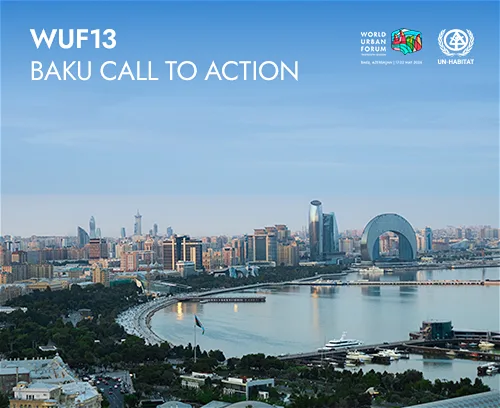
One of the Forum’s principal outcomes was the adoption of the Baku Call to Action, a document reflecting the shared vision of governments, international organisations, cities, civil society and experts in addressing the global housing crisis and advancing implementation of the New Urban Agenda. Appreciation was also expressed to the Government of the Republic of Azerbaijan for the high-level organisation of the thirteenth session of the World Urban Forum, the hospitality extended to participants and the meaningful dialogue fostered throughout the Forum.
The Chair Summary, adopted as one of the key legacy documents of the Forum, reflected the principal directions of international cooperation in the fields of urban planning and sustainable development. The document underscored the importance of jointly developing practical solutions in the areas of urban resilience, affordable housing policies, climate resilience and inclusive urban development, while also highlighting the need to advance the international agenda aimed at addressing the global housing crisis.
The discussions also highlighted the far-sighted policies and strategic leadership of President of the Republic of Azerbaijan Ilham Aliyev in promoting sustainable development, modern urban planning, post-conflict recovery and international cooperation.
The outcomes of WUF13, together with the Baku Call to Action, are also expected to feed into discussions at the United Nations General Assembly High-Level Meeting on the midterm review of the implementation of the New Urban Agenda, scheduled to take place in New York in July 2026.
For the first time in the history of the World Urban Forum, 27 heads of state and government attended the Leaders Summit organised at the initiative of the host country. WUF13 also brought together more than 150 ministers, over 130 mayors, the United Nations Deputy Secretary-General and a number of other senior officials. Among the Forum’s key innovations were the Baku Urban Award, the Business and Innovation Hub, the WUF Academy Campus and the Practices Hub.
On 22 May, the closing ceremony of the thirteenth session of the World Urban Forum took place at the Baku Olympic Stadium, with the cultural programme featuring traditional music and dance performances alongside renditions of Azerbaijani mugham.
As part of the official closing ceremony, Azerbaijan formally passed the presidency of the World Urban Forum to Mexico. The next session of WUF is set to take place in Mexico City in 2028.
The official close of the Forum was also marked by a flag-lowering ceremony at the Baku Olympic Stadium, accompanied by the ceremonial descent of the flags of the United Nations and the Republic of Azerbaijan.