
SPECA Cities Forum and Baku Urban Award Among Key Highlights of WUF13 Day Four
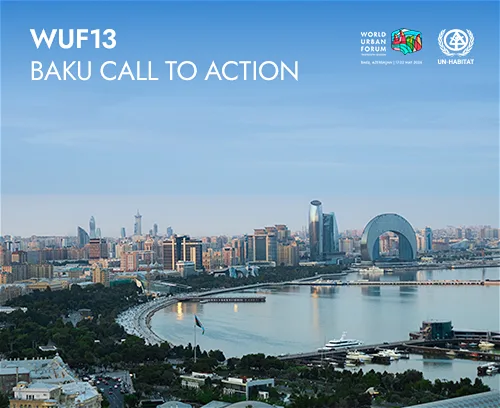
Discussions dedicated to urban development, climate-resilient urbanisation and sustainable development continued on 20 May during the thirteenth session of the World Urban Forum (WUF13) in Baku.
The fourth day of WUF13 featured a broad programme of dialogues, special sessions and caucus meetings held across multiple thematic areas.
A high-level forum titled “Breathing Life into the New Urban Agenda: Integrating Air Quality and Green Infrastructure for Resilient Cities” was held during the thirteenth session of the World Urban Forum (WUF13) at the initiative of Leyla Aliyeva, Vice-President of the Heydar Aliyev Foundation and founder and head of the IDEA Public Union, in partnership with the Clean Air Fund (CAF).
The Forum opened with a message from Leyla Aliyeva addressed to participants. In her remarks, she emphasised that air quality is of critical importance to public health, quality of life and the creation of safe living environments for future generations. She noted that clean air must become one of the central priorities of the modern urban agenda.
Participants were also presented with an overview of initiatives implemented by the IDEA Public Union, including the regeneration of residential courtyards under the “Our Yard” project, as well as wider efforts focused on tree planting, environmental awareness and the promotion of sustainable transport.
The discussions further highlighted the importance of coordinated international efforts aimed at reducing air pollution and advancing greener, more sustainable and people-centred cities.
The Forum concluded with the adoption of the communiqué Baku Call for Breathable Cities. The document calls for clean air to be recognised as one of the fundamental principles of contemporary urban development, for the issue to become a permanent feature on the agenda of future World Urban Forums, and for closer cooperation across urban planning, transport, housing policy, green infrastructure and public health.
The high-level forum also featured an exhibition presenting visual materials by the Clean Air Fund, UNEP and other partners, alongside works created by participants in the international photography initiative Children’s Eyes on Earth.
Building on the wider discussions taking place across WUF13, Baku also hosted the official opening of the SPECA Cities Forum, the first dedicated platform aimed at strengthening cooperation among cities across the SPECA region.
Speaking at the event, Anar Guliyev, Chairman of the State Committee on Urban Planning and Architecture of the Republic of Azerbaijan and National Coordinator for WUF13, noted that the establishment of the Forum during COP29 in Baku in 2024 represented an important milestone in advancing regional cooperation on sustainable urban development.
He emphasised that cities are increasingly at the centre of efforts to address major global challenges, including rapid urbanisation, affordable housing, climate resilience, energy efficiency and digital transformation.
The Forum also saw the signing of a Declaration of Intent to Establish the SPECA Climate-Resilient Cities Forum. Initiated by the cities of Almaty, Arkadag, Bishkek, Dushanbe, Ganja and Samarkand, the SPECA Cities Forum is expected to serve as an important platform for the exchange of experience among cities across the region, the promotion of practical solutions and the development of long-term partnerships.
WUF13 also featured the official presentation of the Baku Urban Award, a new international distinction established at the initiative of the Government of the Republic of Azerbaijan in partnership with the United Nations Human Settlements Programme (UN-Habitat). The Award is aimed at promoting and scaling innovative urban solutions in the fields of sustainable urban development and affordable housing at the international level.
Positioned as one of the principal lasting legacies of WUF13, the Baku Urban Award is expected to serve as an international platform supporting the long-term advancement of the global urban agenda.
It was noted during the presentation that the Award represents another example of Azerbaijan’s active contribution to the global urban and climate agenda. Initiatives undertaken in this direction include the country’s hosting of COP29, the launch of the Multisectoral Actions Pathways (MAP) for Resilient and Healthy Cities and the Baku Continuity Coalition initiatives, co-chairing UN-Habitat’s Open-Ended Intergovernmental Expert Working Group on Adequate Housing for All (OEWG-H), as well as Baku’s hosting of WUF13.
Cooperation between Azerbaijan and UN-Habitat has continued to deepen steadily since the establishment of the Azerbaijan National Urban Forum in 2022. Within this framework, a range of joint initiatives in the fields of urban development and sustainable development have been implemented, including three National Urban Forums held in the Karabakh and Eastern Zangazur economic regions, as well as events organised in Baku in 2023 to mark World Habitat Day.
A dedicated session titled “Baku Urban Award: Scaling Housing Solutions for Global Impact” was also held in connection with the new international distinction. The event brought together Anacláudia Rossbach, Executive Director of the United Nations Human Settlements Programme (UN-Habitat), and Anar Guliyev, Chairman of the State Committee on Urban Planning and Architecture of the Republic of Azerbaijan and National Coordinator for WUF13.
Discussions during the session highlighted the importance of the Award in promoting leading practices in urban development and housing solutions, expanding international cooperation, and encouraging the global exchange of innovative urbanisation approaches.
WUF13 also featured a session titled “Transforming Informal Settlements and Slums for Housing the World”. Addressing the event were Mikayil Jabbarov, Minister of Economy of the Republic of Azerbaijan, and Anacláudia Rossbach, Executive Director of the United Nations Human Settlements Programme (UN-Habitat).
Discussions focused on the transformation of informal settlements and slums, affordable housing policies, social protection mechanisms and inclusive approaches to urban development. Speakers also highlighted the importance of expanding social support systems, strengthening the role of data and statistics, and advancing international cooperation aimed at transforming informal residential areas into sustainable and integrated urban environments.
During the thirteenth session of the World Urban Forum (WUF13), a Memorandum of Understanding (MoU) on cooperation in the fields of urban planning and sustainable development was signed between the State Committee on Urban Planning and Architecture of the Republic of Azerbaijan and the Ministry of Lands, Public Works, Housing and Urban Development of the Republic of Kenya.
The document was signed by Anar Guliyev, Chairman of the State Committee on Urban Planning and Architecture of the Republic of Azerbaijan and National Coordinator for WUF13, and Hon. Alice Wahome, Cabinet Secretary for Lands, Public Works, Housing and Urban Development of the Republic of Kenya.
The MoU envisages expanding cooperation in areas including integrated urban and territorial planning, sustainable urbanisation, smart city solutions, housing policy and contemporary urban development. The parties also highlighted the importance of the agreement in promoting the exchange of experience on sustainable urban development, advancing joint initiatives and strengthening cooperation across international platforms.
As part of WUF13 hosted in Baku, a session titled “The Climate-Housing Nexus: Can we scale climate-resilient housing without deepening inequality or displacement?” brought together discussions on the intersection of climate resilience and housing policy.
Addressing the session, Aghakerim Samadzada, First Deputy Minister of Ecology and Natural Resources of the Republic of Azerbaijan, underscored the importance of factoring climate risks into the development of cities and residential areas.
Discussions focused on climate-resilient housing policies, early warning systems, green urban solutions, energy efficiency and measures aimed at safeguarding vulnerable population groups.
The Forum also hosted a roundtable on the rights of older persons titled “Housing Across the Lifespan: Affordable Housing for All Older Adults”. The event brought together Anacláudia Rossbach, Executive Director of the United Nations Human Settlements Programme (UN-Habitat), alongside urban development experts and representatives of international organisations.
Discussions focused on the challenges posed by ageing populations for cities, affordable housing provision, inclusive urban development, the creation of barrier-free environments and the active integration of older persons into social life.
At the Azerbaijan Pavilion, the Ministry of Ecology and Natural Resources of the Republic of Azerbaijan organised an event titled “Tackling Plastic Pollution: Promoting Liveable Cities and a Circular Economy”.
Speakers at the event included Vugar Karimov, Deputy Minister of Ecology and Natural Resources of the Republic of Azerbaijan; Ambassador Julio Cordano, Chair of the Intergovernmental Negotiating Committee (INC) on the Global Plastics Treaty, who addressed participants via video message; Ismail Serageldin, Co-Chair of the Nizami Ganjavi International Centre; Nigar Arpadarai, Member of the Milli Majlis (Parliament) and COP29 UN Climate Change High-Level Champion; and André Dzikus, Head of the Urban Basic Services Section at the United Nations Human Settlements Programme (UN-Habitat).
A range of events and interactive sessions were also held across several WUF13 platforms, including the WUF Academy, Voices from Cities, SDG in Action, Urban Cinema, Urban Library, the UN-Habitat Arena, the Practices Hub, and the Business and Innovation Hub.